
About This Episode
I’ve heard the advice to eat dessert first because you never know what’s going to happen next.
Which seems like a perfectly reasonable philosophy to me.
But the idea has another layer.
What if the thing we’re saving for later isn’t there when we’re finally ready for it?
And what does that have to do with marketing?
Quite a bit, actually.
Some opportunities have a shelf life
Marketing is constantly changing.
Platforms introduce new features. Algorithms shift. Audience behaviour evolves. Technology creates possibilities that didn’t exist six months ago.
And occasionally, those changes create a window of opportunity.
Maybe a new feature offers businesses a way to reach people they couldn’t reach before.
Maybe a shift in search behaviour creates a gap that hasn’t been filled.
Maybe a new format allows smaller businesses to compete in ways that weren’t previously possible.
For a little while, the landscape is different.
But what do we usually do?
We research.
We plan.
We wait for experts to establish best practices.
And sometimes, by the time we’re ready, the advantage has disappeared.
When preparation becomes procrastination
Preparation is important.
Nobody should make major business decisions based on the latest exciting thing they saw on social media.
But there’s a difference between gathering information that improves a decision and gathering information because we don’t want to make one.
The first is preparation.
The second might just be procrastination wearing a very respectable outfit.
And that distinction matters when an opportunity is time-sensitive.
We tend to focus on the cost of acting too early.
What if the campaign fails?
What if the platform doesn’t work?
What if we waste our time?
Those are fair questions.
But there’s another side.
What if waiting means losing an advantage?
What if experimenting now could teach us something valuable?
What if the opportunity only exists because most businesses haven’t noticed it yet?
Waiting has a cost too.
Being early isn’t always better
Of course, this doesn’t mean every new platform or algorithm change deserves our attention.
Some features disappear.
Some trends never become useful.
Some audiences simply aren’t relevant to our businesses.
And chasing every new development is a remarkably efficient way to accomplish very little.
The point isn’t to be first.
It’s to recognize when timing genuinely matters.
And when it does, you don’t necessarily need to commit your entire marketing strategy.
Sometimes you just need to experiment.
Try a slice
Suppose a platform introduces a feature that might help you reach your audience.
Instead of spending three months researching it or immediately reorganizing your marketing calendar around it, try something small.
Publish one piece of content.
Try a different approach.
Measure the response.
Look beyond vanity metrics.
Did it reach the right people?
Did it generate meaningful engagement?
Did you learn something you can use?
Was the experiment worth the time?
Now you have information you didn’t have before.
And you got it while the opportunity was still developing.
The question worth asking
I think there are three questions worth considering whenever something new appears.
Is this genuinely relevant to my business, or is it simply new?
Will waiting make my decision better, or will it make the opportunity smaller?
What’s the smallest useful experiment I could run?
Because sometimes the best move isn’t to wait for certainty.
It’s to learn while the opportunity still exists.
And sometimes the thing we’re saving for later is exactly the thing we should be trying now.
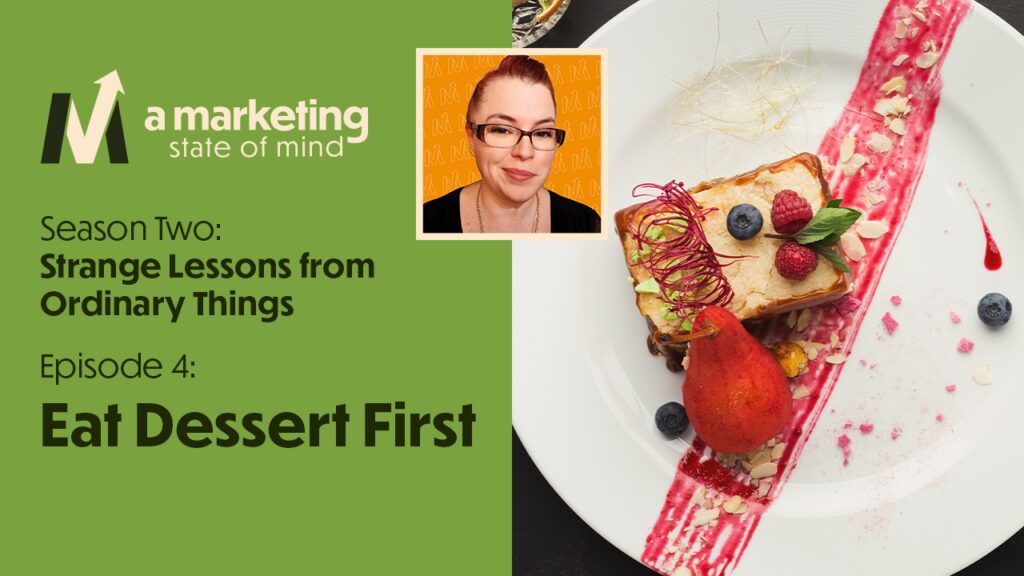
That’s the strange little lesson behind Episode 4 of A Marketing State of Mind.
Eat Dessert First: When Timing Becomes an Advantage
You don’t necessarily need to eat the entire cake.
Sometimes you just need to try a slice.
Listen & Share
🎧 Listen on Apple Podcasts
🎧 Listen on Spotify
▶️ Watch on YouTube
If you enjoyed this episode, subscribe to Marketing State of Mind and share it with someone who needs it.